
Ultrasonic Cleaners
(7 Article in 46 versions)An ultrasonic parts cleaner provides thorough, gentle cleaning for components that may be difficult to clean by hand. DENIOS ultrasonic cleaners help remove grease and other contamination from surfaces, recesses and hard-to-reach areas, with a range of sizes available to suit different parts and applications.

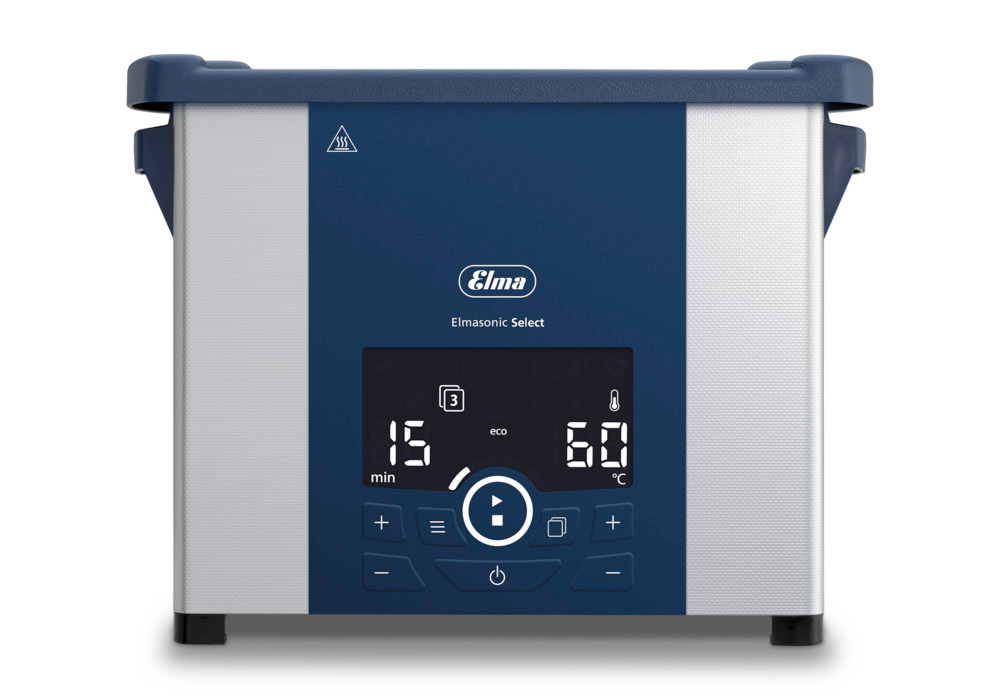


Ultrasonic Parts Cleaners from DENIOS
The DENIOS range includes ultrasonic parts cleaners for different cleaning requirements, from smaller components to more demanding industrial applications. Used with a suitable cleaning agent, these systems can remove oils, grease and other residues while reducing reliance on manual scrubbing.
Different tank sizes and capacities are available to accommodate a variety of components. Stainless steel tanks and housings provide a robust construction for professional use, while model-specific controls allow cleaning time, temperature and ultrasonic modes to be adjusted according to the application.
Various ultrasonic frequencies are also available across the range. For example, Elmasonic Easy models operate at 37 kHz, while selected Elmasonic xtra ST units offer 25 kHz for more stubborn contamination and 45 kHz for gentler cleaning of sensitive materials. Suitable cleaning agents and accessories are also available to support the cleaning process.

How Does an Ultrasonic Parts Cleaner Work?
An ultrasonic parts cleaner uses high-frequency sound waves to create microscopic bubbles in water or a suitable cleaning solution. This process, known as cavitation, provides the cleaning action needed to loosen dirt and residues from component surfaces.
The process works as follows:
Ultrasonic vibrations: High-frequency sound waves pass through the cleaning liquid, creating alternating high- and low-pressure phases.
Bubble formation: Microscopic cavitation bubbles form and expand as the pressure changes.
Bubble collapse: The bubbles rapidly collapse, producing pressure impulses and small liquid jets close to the surface of the component.
Contamination removal: These forces loosen dirt and residues from exposed surfaces as well as holes, gaps, recesses and other difficult-to-access areas.
Frequency control: Lower frequencies generally create stronger cavitation for robust components and stubborn contamination, while higher frequencies provide gentler cleaning for more sensitive surfaces.
This method makes ultrasonic parts cleaners suitable for a range of applications where manual cleaning would not be appropriate or easy, including cleaning engineering components, automotive parts, machine components, tools and small mechanical parts.
The appropriate frequency, cleaning solution, temperature and cycle time should be selected according to the specific material, component geometry and type of contamination.
What Are the Benefits of Ultrasonic Cleaners?
Ultrasonic cleaners offer a thorough and repeatable way to clean components, particularly where manual methods may struggle to reach intricate surfaces or internal areas.
Cleans hard-to-reach areas: Cavitation bubbles form throughout the cleaning liquid, helping reach gaps, recesses, holes and other areas that brushes or cloths may not access effectively.
Effective parts cleaning: Ultrasonic cleaning can loosen dirt, grease, oil and other residues from component surfaces when used with suitable cleaning settings and cleaning agents.
Consistent cleaning results: Controlled parameters such as cleaning time, temperature, and ultrasonic frequency can help create a repeatable cleaning process.
Reduces manual cleaning: The cleaning action can reduce the need for hands-on scrubbing, particularly for small or intricate components.
Suitable for complex components: Because the cleaning liquid surrounds immersed parts, ultrasonic cleaning is well suited to components with detailed geometries, cavities and difficult-to-access surfaces.
Choosing the Right Ultrasonic Parts Cleaner
Choosing the right ultrasonic parts cleaner depends on the components being cleaned, the type of contamination and the required cleaning process. Key factors to consider include:
Tank capacity: The tank should be large enough to accommodate the parts and cleaning solution without overloading the unit.
Component size and loading capacity: Check the internal tank dimensions and permitted load so parts can be positioned correctly for effective cleaning.
Ultrasonic frequency: Lower frequencies generally provide more intensive cleaning for robust components and stubborn contamination, while higher frequencies are better suited to more delicate parts and surfaces.
Heating: Heated cleaning can improve performance for certain contaminants and cleaning agents, so consider whether temperature control is required for the application.
Cleaning time and controls: Adjustable or programmable cycles can help tailor the process to different parts and levels of contamination.
Accessories: Baskets, lids, rinsing or drying equipment and suitable cleaning agents can support handling and help create a more complete cleaning process.
DENIOS offers a wider range of parts cleaners and washing tables and can provide technical advice to help identify the most suitable cleaning solution for your specific requirements.
FAQS
What Can You Clean in an Ultrasonic Cleaner?
Ultrasonic cleaners can be used for a range of small and complex components, including engineering parts, automotive parts, machine components, tools and small mechanical parts. Suitability depends on the material, component design, contamination and cleaning settings used.
Will an Ultrasonic Cleaner Remove Grease and Oil?
Yes, an ultrasonic parts cleaner can help remove grease, oil, dirt and other residues when used with a suitable cleaning solution and appropriate settings. Cavitation helps loosen contamination from exposed surfaces as well as recesses and other difficult-to-access areas.
What Size Ultrasonic Parts Cleaner Do I Need?
Choose a tank size that can accommodate the components and cleaning solution without overloading the unit. The internal dimensions, tank capacity and permitted loading capacity should all be considered alongside the size and quantity of parts being cleaned.
What's the Difference Between an Ultrasonic Cleaner and a Parts Cleaner?
An ultrasonic cleaner is a type of parts cleaner that uses high-frequency sound waves and cavitation in a cleaning liquid to loosen contamination. Other parts cleaners may use different cleaning methods, so the most suitable option depends on the components and cleaning requirements.